How to Can Tomatoes Safely (and Why You Add Acid)
Why home-canned tomatoes require added acid, how to add bottled lemon juice or citric acid correctly, and a step-by-step overview of the safe canning process.
Tomatoes seem like the perfect canning candidate. They come off the vine in late summer abundance, they're what your grandmother canned for decades, and — here's where beginners often get tripped up — most people assume they're safely acidic enough to can on their own. They are not, at least not reliably. This guide explains exactly why modern tested recipes require you to add acid to every jar of home-canned tomatoes, and walks you through the step-by-step process so your pantry shelves stay safe all winter long.
Are Tomatoes High-Acid or Low-Acid?
Tomatoes sit right at the edge of the safe zone. Foods with a pH at or below 4.6 can be processed in a water-bath canner because that level of acidity prevents Clostridium botulinum spores from germinating. Foods above that threshold need pressure canning to reach temperatures that destroy the spores outright.
The problem with tomatoes is that their natural pH hovers right around 4.0 to 4.6, depending on:
- Variety. Heirloom and paste varieties vary widely. Some yellow or orange varieties read noticeably less acidic than classic red slicers.
- Ripeness. Fully ripe or overripe tomatoes tend to have a higher (less acidic) pH than those picked slightly underripe.
- Growing conditions. Soil, sunlight, and watering patterns all affect the final chemistry in a way that is completely invisible to the eye.
Because you cannot look at a tomato and know its pH, the USDA and the National Center for Home Food Preservation (NCHFP) treat tomatoes as borderline. Their conclusion is straightforward: you must add an acidifying agent to every jar, every time, regardless of whether you are water-bath canning or pressure canning. The added acid guarantees the jar reaches a safe pH even if the tomatoes themselves happen to be on the wrong side of 4.6.
Why Bottled Lemon Juice Is the Standard Choice
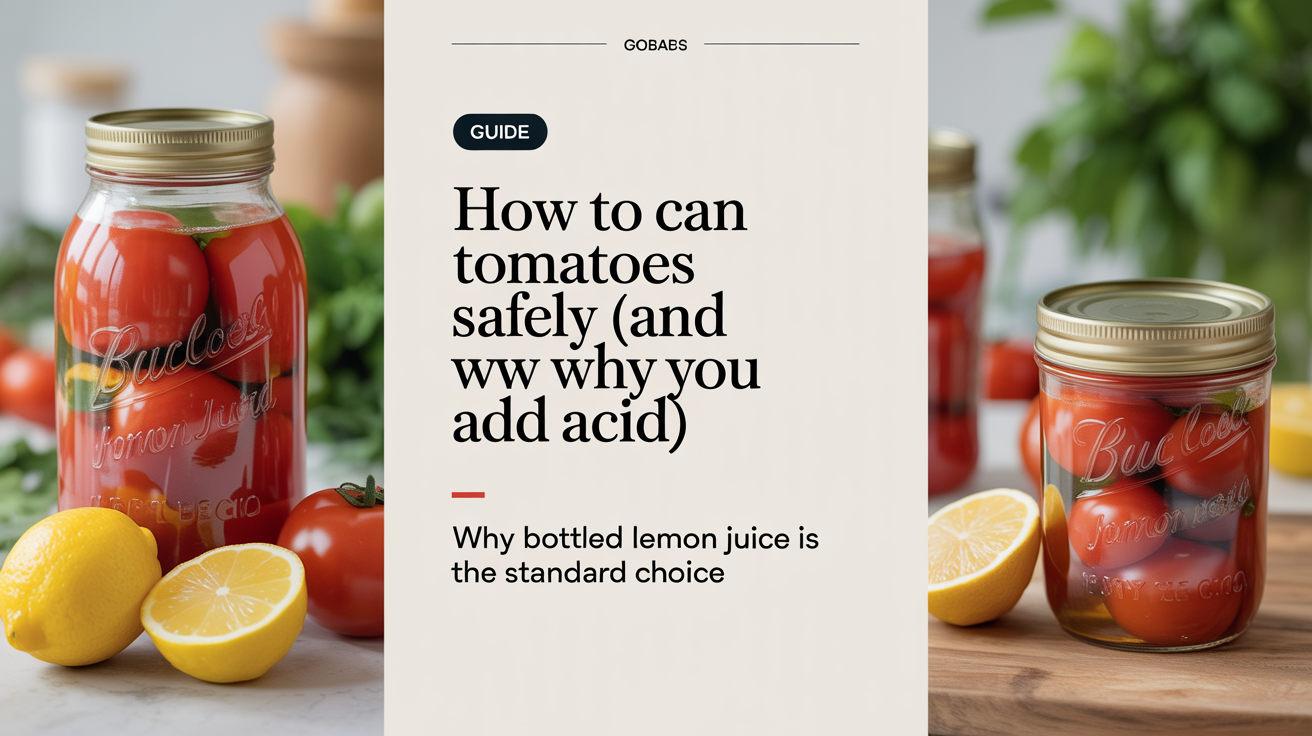
When tested recipes call for lemon juice, they specify bottled, not fresh. This matters more than it sounds. Fresh lemons vary in acidity from fruit to fruit and season to season. Bottled lemon juice is standardized to a consistent acidity (typically around 5%), so the amount in a tested recipe reliably acidifies the jar every time. Using fresh lemon juice instead introduces an unknown variable into a food-safety equation where unknowns are exactly what you are trying to eliminate.
Citric acid powder is the other widely accepted option. It works the same way chemically and has no noticeable effect on flavor at the amounts used. What you should not use is white vinegar as a substitute without a recipe specifically written for it; different acidifiers have different strengths, and swapping them outside of a tested recipe breaks the safety guarantee.
What Tested Recipes Typically Specify
Most current tested recipes (from USDA, NCHFP, or Ball) call for adding acid to each jar before filling it with hot tomatoes. The amounts commonly cited are:
- Bottled lemon juice: about 1 tablespoon per pint jar, 2 tablespoons per quart jar
- Citric acid: about 1/4 teaspoon per pint jar, 1/2 teaspoon per quart jar
These figures come from controlled laboratory testing, not from tradition or approximation. Always verify the current amounts in the specific recipe you are following, since guidelines can be updated. Do not scale or estimate; use a measuring spoon.
Salt is optional and added purely for flavor, not for preservation. It does not affect safety or acidity.
Water-Bath vs. Pressure Canning Tomatoes
A question that trips up many beginners: if you pressure can tomatoes, do you still need to add acid? Yes. The two methods address different risks.
Water-bath canning reaches 212 degrees Fahrenheit at sea level, which is sufficient only for high-acid foods because the acid itself suppresses botulinum growth. Pressure canning pushes temperatures up to 240 to 250 degrees Fahrenheit, which does destroy botulinum spores. But pressure-canned tomato recipes still require added acid because the process was tested and validated with the acid present. Removing it would mean using an untested method, which the USDA does not recommend.
The short version: added acid is not a substitute for the right processing method. It is a required ingredient in every tested tomato canning recipe, full stop.
For a closer look at when water-bath canning is appropriate versus when you need a pressure canner, see what foods you can water-bath can.
Step-by-Step Overview: Canning Whole or Crushed Tomatoes
Before you begin, choose a specific tested recipe from USDA, NCHFP, or Ball and follow it exactly. The steps below describe the general sequence; the exact headspace, acid amount, and processing time come from your chosen recipe.
-
Gather your equipment. You need a water-bath canner or pressure canner, canning jars (inspect for chips or cracks), new lids, clean rings, a jar lifter, a canning funnel, and a timer.
-
Sterilize or heat your jars. Keep jars hot until you fill them to prevent thermal shock. Lids should be kept in hot (not boiling) water per current manufacturer directions.
-
Blanch and peel the tomatoes. Score an X on the bottom of each tomato, dip in boiling water for 30 to 60 seconds, then transfer to ice water. The skins slip right off. Core and halve or quarter them, removing any bruised or soft spots.
-
Prepare your tomatoes. For whole or halved tomatoes packed in their own juice, press the halves into a pot and bring to a boil, crushing slightly to release liquid. For crushed tomatoes, quarter them into a large pot and cook until soft. For tomato juice, cook and strain through a food mill.
-
Add acid to each hot jar. Measure carefully. If your recipe calls for 1 tablespoon of bottled lemon juice per pint, add it directly to the empty hot jar before any tomatoes go in.
-
Add salt if desired. Optional, flavor only. Typically 1/2 teaspoon per pint or 1 teaspoon per quart.
-
Fill jars with hot tomatoes. Ladle in the hot tomatoes and liquid, leaving the headspace your recipe specifies. Keeping everything hot helps drive air out of the jar.
-
Remove air bubbles. Slide a thin spatula or bubble remover around the inside edge of the jar. Recheck headspace and adjust if needed.
-
Wipe jar rims. A clean, damp cloth removes any residue that could prevent a good seal.
-
Apply lids and rings. Finger-tight only. Overtightening prevents air from venting during processing.
-
Process according to your tested recipe, adjusted for altitude. Processing times for water-bath canning are calibrated for sea level. At higher elevations, water boils at a lower temperature, so you need additional processing time or pressure. If you have not accounted for this, read about how to adjust canning for your altitude before you start.
-
Cool jars undisturbed for 12 to 24 hours. Do not press down on the center of lids to test them while they are still hot. Let the jars cool completely, then check that each lid has sealed (it will not flex up and down). Remove rings, label with contents and date, and store in a cool, dark place.
For a detailed walkthrough of the water-bath process itself, see the step-by-step guide to water-bath canning.
Sauces, Salsas, and Anything with Added Vegetables
Plain tomatoes, crushed tomatoes, and tomato juice follow their own tested recipes. The moment you add onions, peppers, garlic, celery, or other low-acid vegetables, the equation changes. Those additions raise the overall pH of the mixture and can push a jar into unsafe territory.
This is why you must use a tested recipe for any tomato-based sauce or salsa rather than adapting your own. A recipe that has been tested in a laboratory accounts for the specific proportions of each ingredient and sets a processing method and time that makes the finished product safe. Scaling the recipe up or down in ways not indicated in the recipe, or swapping in extra peppers because your garden is overflowing, changes the safety profile.
If a sauce recipe you love has not been tested, the safest path is to water-bath can the tomatoes plain (with required acid) and add the other ingredients when you open the jar to cook. It takes more jars, but it keeps the process inside tested territory.
FAQ
Do I have to add lemon juice even if my tomatoes taste really sour?
Yes. How a tomato tastes gives you no reliable information about its actual pH. A tomato can taste sharp or bright from compounds other than acid. The only way to know whether a jar is safe is to follow a recipe that was designed and tested to guarantee a safe pH after processing.
Can I use apple cider vinegar instead of lemon juice?
Some tested recipes do specify vinegar as an acidifier, but you cannot substitute it for lemon juice in a recipe that calls for lemon juice. Different acidifiers have different strengths and affect flavor differently. Use whatever your recipe specifies, in the amount it specifies.
My grandmother never added lemon juice. Were her canned tomatoes unsafe?
Canning recommendations have evolved as food scientists learned more about the variability of tomato acidity. Older recipes predate that research. Many jars processed without added acid were probably fine, but the risk was real and unpredictable. Current tested recipes require added acid because that is what the science shows is necessary to guarantee safety across all varieties and conditions.
Can I reduce the lemon juice to avoid changing the flavor?
No. The amount in a tested recipe is a minimum safety threshold, not a suggestion. If you find the lemon flavor noticeable, citric acid is flavorless at the small amounts used and provides the same acidification.
How long do properly canned tomatoes last?
The USDA generally recommends using home-canned goods within one to two years for best quality, though properly sealed jars can remain safe longer. Quality -- color, texture, flavor -- declines over time even in sealed jars. Always inspect before opening: discard any jar with a broken seal, bulging lid, spurting liquid, or off smell. Never taste food from a jar you suspect may be spoiled.