How Pectin Works: Getting Your Jam to Set
Learn how pectin, acid, and sugar work together to gel jam, which fruits need added pectin, and how to fix a batch that won't set.
Pectin is the reason a pot of mashed fruit turns into something you can spread on toast, and understanding it makes the difference between a confident jam maker and someone staring at a runny jar wondering what went wrong. Pectin is a naturally occurring fiber found in fruit, and when it meets the right amount of acid and sugar under heat, it forms a soft, sliceable gel. Get those three things in balance and your jam sets. Tip one of them too far off and you end up with fruit syrup, or worse, something closer to rubber.
What Pectin Actually Is
Pectin lives in the cell walls and skin of fruit. It acts as a kind of natural glue that holds plant cells together. When fruit is cooked, heat breaks down those cell walls and releases pectin into the surrounding liquid. Left on its own, dissolved pectin stays liquid. Give it the right conditions, though, and the pectin molecules link up into a three-dimensional mesh that traps liquid inside. That mesh is a gel.
The amount of pectin released varies enormously from one fruit to the next. That's why some fruits set on their own and others need help.
High-Pectin Fruits
These fruits are naturally rich in pectin and often set without any commercial pectin added, especially if you include a portion of slightly underripe fruit (which carries more pectin than fully ripe):
- Apples and crab apples
- Tart citrus fruit (lemons, limes, oranges) and citrus peel
- Cranberries
- Currants (red and black)
- Gooseberries
- Quince
Many classic jam recipes for these fruits are simply fruit, sugar, and lemon juice; the fruit brings all the pectin the gel needs.
Low-Pectin Fruits
These are delicious but they don't gel reliably on their own:
- Strawberries
- Peaches and nectarines
- Blueberries
- Sweet cherries
- Pears
- Figs
Recipes for these fruits either add commercial pectin, blend in a high-pectin fruit (strawberry-apple jam is a classic), or call for added lemon juice to bring up the acid level. Some older no-pectin recipes work by cooking much longer to concentrate the fruit solids, which trades convenience for time and reduces your yield.
The Three Things a Gel Needs
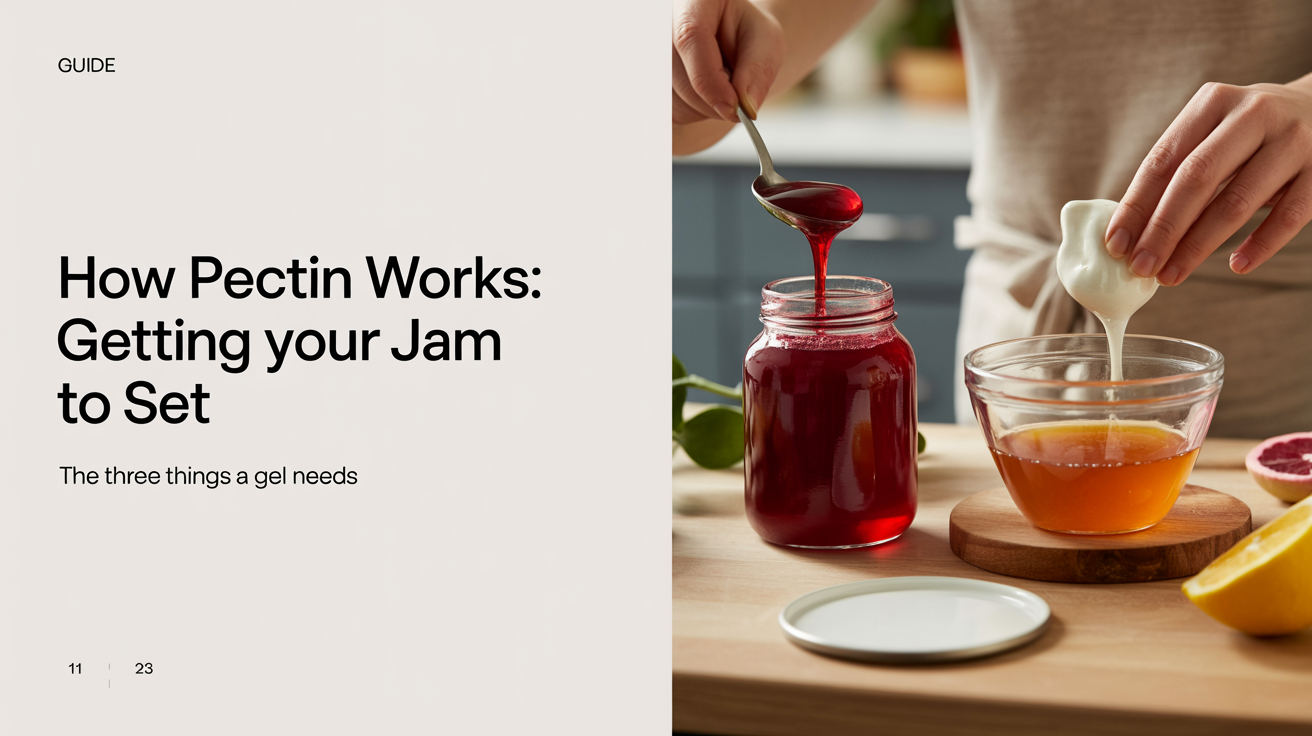
Pectin alone isn't enough. A jam gel requires pectin, acid, and sugar working together.
Pectin
This is the structural backbone. Whether it comes from the fruit itself or from a box of commercial pectin, you need enough of it in the pot for the gel mesh to form. Too little and the jam stays loose no matter how long you cook it.
Acid
Acid does two things: it helps pectin molecules bond to each other, and it brightens the flavor of the finished jam. Most tested recipes call for added lemon juice, especially with low-pectin or low-acid fruits. If your fruit is naturally tart (currants, citrus), the acid is already there. Without enough acid, the gel either won't set or will be weak and weepy.
Sugar
Sugar isn't only there for sweetness. It pulls water away from the pectin molecules, allowing them to cluster and bond. It also acts as a preservative by lowering the water activity of the finished jam. Standard jam recipes call for a lot of sugar, often close to a 1:1 ratio with fruit. Reducing sugar without using a specially formulated low-sugar pectin (more on that below) throws off the gel.
Heat and the Setting Point
Heat is what gets the gel started, but knowing when to stop cooking matters just as much. The traditional benchmark is the setting point: approximately 220 degrees F (104 degrees C) at sea level. At high altitude, the boiling point of water drops, so the setting point also drops by about 2 degrees F for every 1,000 feet above sea level. A candy or instant-read thermometer is useful here, but the cold-plate test (described below) is more reliable.
Types of Commercial Pectin and Why It Matters
If your fruit is low in natural pectin, or if you want a reliable, consistent result without a long cook, commercial pectin is the practical solution. There are a few types, and they are not interchangeable.
| Type | Form | Use |
|---|---|---|
| Regular powdered pectin | Powder, mixed dry into fruit before heating | Standard jam/jelly recipes with full sugar |
| Liquid pectin | Liquid, stirred in after the boiling point | Standard recipes; added at a different stage than powder |
| Low-sugar / no-sugar-needed pectin | Powder, specially formulated | Reduced-sugar or no-sugar recipes; different gelling chemistry |
| Instant / freezer jam pectin | Powder | No-cook freezer jams only; not for water-bath canning |
The critical rule: always use the recipe that came with your specific pectin product, or a tested recipe from a trusted source (USDA, the National Center for Home Food Preservation, Ball, or the pectin package insert) that matches your pectin type. Swapping liquid for powdered pectin in a recipe, or reducing the sugar in a standard pectin recipe, changes the chemistry and can produce a jam that doesn't set, or in the case of sugar reduction, one that is under-preserved.
If you want to make low-sugar jam, reach for a pectin product specifically designed for it rather than just cutting the sugar in a standard recipe.
How to Test Whether Your Jam Is Setting
Waiting for a thermometer to hit 220 degrees F tells you something, but fruit varies in pectin content and the plate test tells you more directly whether the gel has actually formed.
The Cold-Plate Test
Before you start cooking, put two or three small plates in the freezer. When you think the jam might be close to done, pull one plate out, drop a small spoonful of jam onto it, and put it back in the freezer for one to two minutes. Then push the jam with your finger.
- If the surface wrinkles and the jam holds its shape, it has reached the set point.
- If it slides or flows like liquid, cook a few more minutes and test again with a fresh cold plate.
This test bypasses thermometer accuracy issues and gives you a direct look at the gel in action.
The Sheet Test
Dip a cold metal spoon into the boiling jam and hold it horizontally. Early in cooking, jam drips off in separate drops. When it's close to setting, two drops will merge at the edge of the spoon and sheet off together in a wider drop rather than two distinct ones. This is more of a rough signal than a precise endpoint; the cold-plate test is more reliable.
Why Jam Fails to Set (and What to Do)
A batch that won't set is one of the most common frustrations in jam making. Here are the usual culprits.
Not Enough Pectin or Acid
Very ripe fruit has less pectin than slightly underripe fruit. If you used fully ripe or overripe fruit and a recipe that depended on natural pectin, the gel may simply not have enough structural material. The fix for future batches is to use a mix of ripe and slightly underripe fruit, or switch to a tested recipe that adds commercial pectin. Adding a splash more lemon juice next time also helps bring up the acid.
Under- or Over-Cooking
- Undercooked: The jam never reached the setting point. The gel didn't fully form.
- Overcooked: Cooking too long beyond the set point breaks down the pectin structure. The jam may look thick in the pot but turn grainy or weepy in the jar.
Too Much or Too Little Sugar
Altering the sugar ratio in a standard pectin recipe throws off the gel balance. Always follow a tested recipe and measure accurately.
Fixes for a Batch That Didn't Set
If your jam is already in sealed jars and it's runny, you have options. You can reopen the jars and reprocess the batch, but doing this correctly means following a tested recipe for recooking with pectin, and you'll need to use new lids. The NCHFP and Ball publish guidance on remaking soft jam. Some people simply store runny jam in the fridge and use it as a syrup or sauce within a few weeks rather than going through a second process.
For your next jam-making session, keep notes on what you changed so you can diagnose the problem and adjust the approach.
FAQ
Can I reduce the sugar in my jam recipe?
Not without switching to a pectin product formulated for low- or no-sugar use. Sugar is part of the gelling chemistry in standard pectin, not just a flavoring. Cutting it in a regular recipe produces a jam that won't set reliably and may not be adequately preserved. Low-sugar pectins are widely available and come with tested recipes that account for the different chemistry.
What's the difference between liquid and powdered pectin?
Both gel jam, but they work differently and are added at different points in the cooking process. Powdered pectin is typically stirred into the raw fruit before heating; liquid pectin is added after the mixture reaches a boil. They require different recipes, and using one in a recipe written for the other will almost certainly give you a bad set. Always match your pectin type to the recipe.
My jam set in the pot but was runny once I opened the jar weeks later. What happened?
This is sometimes called "weeping" or syneresis. It can happen when the acid-pectin-sugar balance was slightly off, the jam was overcooked just past the set point, or the jar was disturbed while the gel was forming (jars should rest undisturbed after water-bath processing). A jam that weeps is usually still safe to eat; store it in the fridge and use it up.
Do I need to add pectin to make jam?
Only if your fruit is low in natural pectin or you want the convenience of a shorter cook and a more predictable set. High-pectin fruits like apples, currants, and citrus can form a gel on their own with just sugar and some acid. Whether you use natural or added pectin, follow a tested recipe and don't freelance the ratios.
Is there a pectin that works without any sugar at all?
Some no-sugar pectins (often labeled "no-sugar-needed" or "for diabetic diets") can gel with alternative sweeteners or even unsweetened. These products come with specific tested recipes and require careful attention to the instructions. The finished product will need to be refrigerated or frozen unless the tested recipe specifies it's safe for water-bath canning. Some no-sugar formulations are only suitable for refrigerator or freezer storage.