Dial Gauge vs Weighted Gauge Pressure Canners
Learn how dial gauge and weighted gauge pressure canners differ, when each type suits your needs, and how altitude affects which gauge to choose.
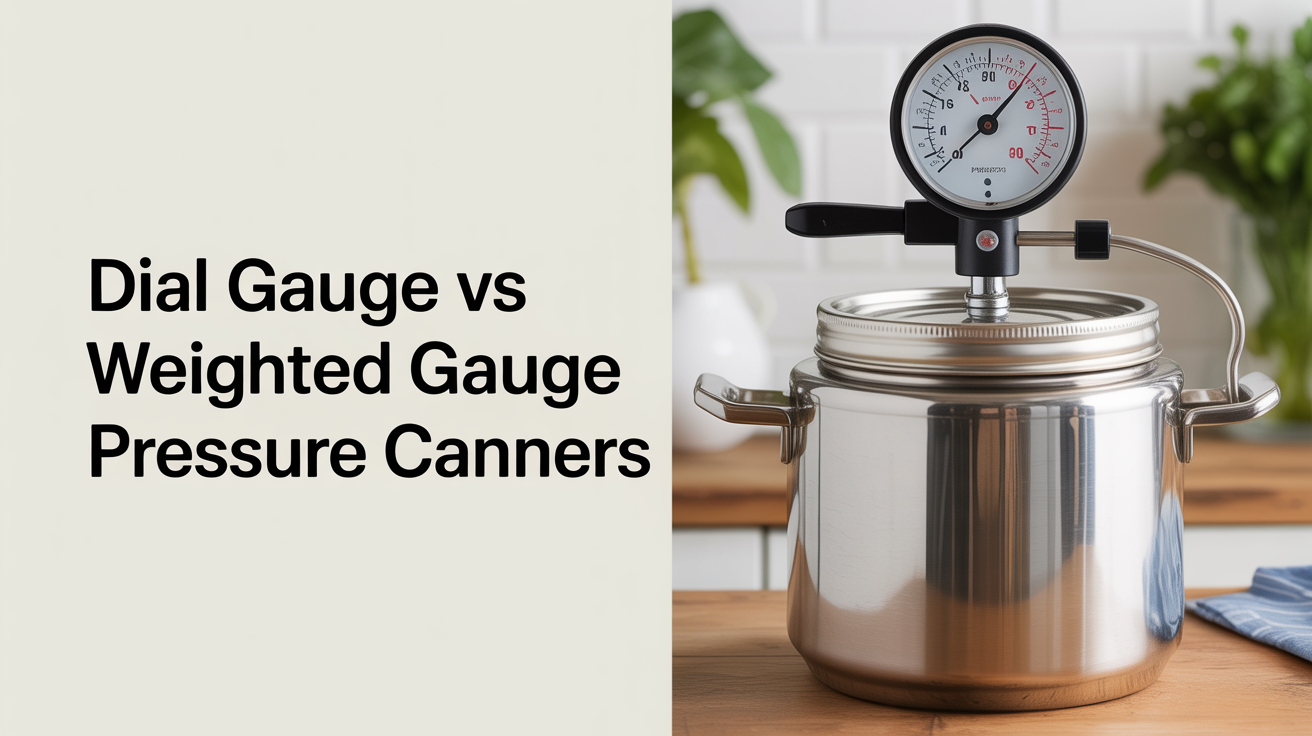
Choosing a pressure canner means choosing a gauge type, and the two options work in meaningfully different ways. A dial gauge gives you a numeric readout of the pressure inside the canner. A weighted gauge regulates pressure on its own by rocking or jiggling at a set level. Neither type is universally better, but each has practical trade-offs worth understanding before you buy or borrow one.
If you are still sorting out what gear you need first, the overview at canning equipment for beginners is a good starting point.
How a Dial Gauge Works
A dial gauge canner has a pressure indicator mounted on the lid that displays a numerical reading, typically in pounds per square inch (PSI). You watch the dial as you process food and adjust the heat to keep the needle at the pressure called for in your recipe.
The advantage is precision: you can see exactly where the pressure sits at any moment, and you can hit specific PSI increments that some recipes call for.
The drawback is that dial gauges can drift over time. A gauge that reads 11 PSI might actually be delivering 9 PSI or 13 PSI, and you would not know from looking at it. An inaccurate gauge matters a great deal with low-acid foods because the pressure determines whether the temperature inside the canner is high enough to destroy harmful bacteria. Dial gauge canners must be tested for accuracy every year, or before each canning season at a minimum. Most cooperative extension offices offer this service free or at low cost.
If a dial gauge tests inaccurate by more than a small margin, the manufacturer or your extension office will advise you on what adjustment to make when setting pressure. A gauge that is off significantly should be replaced.
How a Weighted Gauge Works
A weighted gauge canner uses a weighted regulator, usually a separate piece that sits over the vent pipe, to control pressure automatically. When the pressure inside the canner reaches the set level, the weight rocks or jiggles, releasing just enough steam to hold pressure steady.
You do not read a number; you listen and watch for the rocking pattern. Once the weight is jiggling steadily, the canner is at its operating pressure, and you adjust heat to keep that rhythm consistent.
A weighted gauge requires no annual testing or calibration. Because the physical weight determines the pressure rather than a dial needle, there is no mechanism to drift out of accuracy. This makes weighted gauge canners lower-maintenance over time.
The trade-off is fewer pressure settings. Most weighted gauges offer two options: 5 PSI and 10 PSI, or 10 PSI and 15 PSI, depending on the model. You cannot fine-tune to an intermediate pressure the way a dial gauge allows.
Altitude Handling: Where the Difference Matters Most
Water boils at a lower temperature as elevation increases, and pressure canners compensate by running at higher pressure. Altitude adjustments are built into every tested recipe.
For dial gauge canners, recipes typically specify different PSI levels for different altitude ranges. Because you can read an exact number, hitting a specific pressure increment for your elevation is straightforward.
For weighted gauge canners, altitude adjustment is simpler but less granular. At elevations above 1,000 feet, you generally switch to the higher weight setting. Because you only have two or three weight options rather than an infinite dial, there is less flexibility, but for most home canners the difference is not a practical problem.
Always follow the altitude guidelines in your specific recipe from the USDA Complete Guide to Home Canning, the National Center for Home Food Preservation (NCHFP), or a current Ball resource. Do not apply adjustments from memory or from an untested source.
Maintenance and Long-Term Reliability
A dial gauge canner requires more ongoing attention:
- Annual gauge testing is mandatory for food safety
- The gauge itself is a replaceable part; if it breaks or tests inaccurate beyond adjustment, you need a new gauge
- Gaskets and seals on both canner types should be inspected each season and replaced when worn
A weighted gauge canner has fewer moving parts to maintain. The weight regulator is durable and does not require calibration. Routine maintenance is limited to cleaning the vent pipe, checking the gasket, and making sure the petcock (if present) moves freely.
Both types have similar lifespans when cared for properly. Canners from established manufacturers have been in use for decades, and replacement parts are generally available for current models.
| Feature | Dial Gauge | Weighted Gauge |
|---|---|---|
| Pressure display | Numeric readout (PSI) | Jiggling/rocking weight |
| Calibration needed | Yes, annually | No |
| Pressure settings | Adjustable to any PSI | Two or three fixed levels |
| Altitude adjustment | Specific PSI increments | Switch to higher weight above 1,000 ft |
| Maintenance | Higher (annual testing) | Lower |
| Accuracy risk | Can drift over time | Self-regulating by design |
Which Type Should You Choose
There is no single right answer, but a few factors tend to point one direction.
If you live at an elevation where precise PSI increments matter, or if you enjoy monitoring the process closely, a dial gauge gives you more information. Just commit to having it tested every year before you use it.
If you prefer a more hands-off approach to monitoring, or if you want fewer maintenance responsibilities, a weighted gauge is simpler to manage over time. The fixed pressure settings cover the vast majority of home canning recipes.
If you are borrowing or inheriting a canner, find out which type you have before your first use. For a dial gauge, get it tested before processing anything. For a weighted gauge, confirm the weight setting options match what your recipes call for at your altitude.
Both gauge types, when used correctly with tested recipes and proper technique, produce safe canned food. The gauge is one variable among several, and following the recipe exactly matters more than which type you own. For a closer look at the jars and lids that work with either canner type, see mason jar sizes explained and canning lids and bands.
Frequently Asked Questions
How often does a dial gauge need to be tested?
The USDA and NCHFP recommend testing a dial gauge for accuracy at least once a year, ideally before your canning season begins. Most cooperative extension offices offer free testing. Do not skip this step, as an inaccurate gauge can result in under-processed food, which poses a serious safety risk with low-acid foods.
Can I use a dial gauge canner without testing it if it looks fine?
No. A dial gauge that looks undamaged and reads smoothly can still be off by several PSI. The only way to know it is accurate is to have it tested against a calibrated standard. A gauge that appears normal but reads high will cause you to under-process food; one that reads low will cause you to over-process and may indicate a problem with the canner.
Does a weighted gauge canner ever need calibration?
No. The weighted gauge regulates pressure through the physical weight of the regulator, not through a needle or spring mechanism. There is nothing to calibrate. Routine maintenance such as cleaning the vent pipe and inspecting the gasket is still necessary, but accuracy testing is not.
Can I switch between gauge types by swapping parts on my canner?
No. Dial gauge and weighted gauge canners are different designs and are not interchangeable. If you want to use a different gauge type, you need a different canner. Some canner models do come with both a dial gauge and a weighted regulator, which gives you the option to use either method with the same pot.
What should I do if my dial gauge tests inaccurate?
Your cooperative extension office or the canner manufacturer can advise on how much to adjust your pressure setting to compensate for the inaccuracy. If the gauge is off by more than the acceptable range, replace it before canning again. Using a known-inaccurate gauge without a verified adjustment plan is not a safe workaround.