Labeling and Tracking Your Canned Pantry
Learn how to label home canned jars correctly, organize your canning pantry, and use a simple inventory log to rotate stock safely.
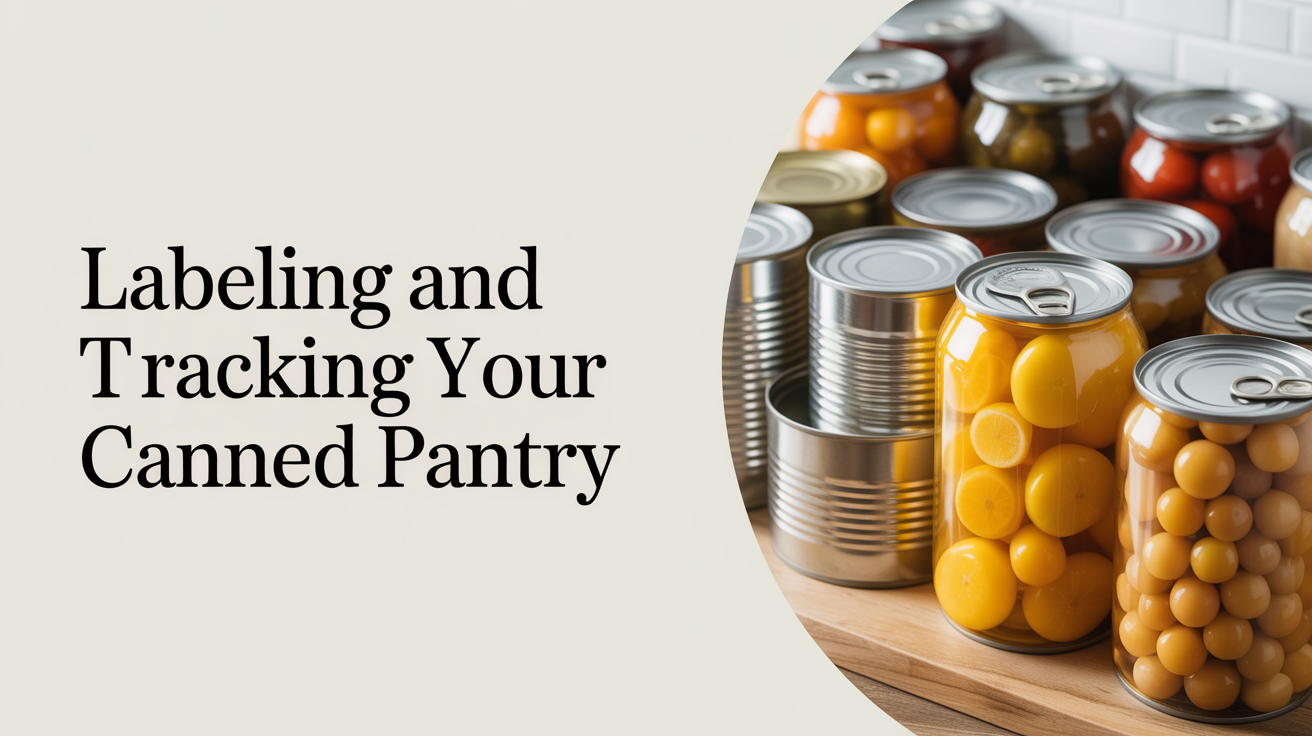
A jar of home-canned tomatoes looks the same in March as it did in August. Without a label, you have no way to know what's inside, when it was processed, or which recipe produced it. Good labeling takes thirty seconds per jar and pays back every time you reach for a shelf.
What to Write on Every Label
A useful canning label contains three pieces of information: the contents, the date it was processed, and the recipe source.
Contents should be specific enough to be useful. "Tomatoes" is fine for a single variety; "Roma tomatoes, crushed" is better if you put up several types. For jams and pickles, include the flavor or style ("bread-and-butter pickles," "peach-ginger jam") so you can grab the right jar without opening several.
Date canned means the processing date, not the date you filled the jar. Write the full month and year at minimum: August 2026. Some canners add the day, which helps if you run multiple batches in the same week. The date is what lets you practice first-in, first-out rotation and tells you how long a jar has been on the shelf.
Recipe source and batch notes are optional but worth developing into a habit. Noting "Ball Complete Guide p. 214" or "NCHFP peach halves, light syrup" makes it easy to cross-reference headspace, processing time, and yield if you ever want to verify the method later. A batch number or letter (A, B, C) helps if you're tracking which jars came from which picking day.
Where to Put the Label
Canners disagree on lid-top versus side-of-jar, and both work. The practical difference matters when jars are stacked or stored in a dark pantry.
A label on the lid is visible at a glance when jars sit in a row on a shelf. Permanent marker on the lid is the simplest approach. The lid goes with the jar until you open it, so date and contents stay together. One drawback: if you store jars in boxes or stacking racks where lids face up, a side label is easier to read without lifting anything.
A label on the side of the jar works well for deep shelves or when you want to include more detail than fits on a lid. Use freezer tape or canning labels that peel off cleanly; address labels from an office supply store also work. Avoid labels that leave adhesive residue, which makes jars harder to wash and reuse.
Do not write on the band. Bands are removed after confirming the seal, and they rotate between jars. Any information on a band will end up with the wrong contents.
Confirming a Good Seal Before You Store
Before a jar earns a shelf spot, confirm the seal. Press the center of the lid: it should be firm, slightly concave, and should not flex up and down. If it pops, the jar did not seal properly and belongs in the refrigerator for short-term use. For more detail on what a failed seal looks and feels like, see the guide on how to tell if a canning seal failed.
Once you confirm a good seal, remove the band, wipe the jar clean, and label it. Storing jars with bands on can hide corrosion and makes it harder to spot lid problems later.
First-In, First-Out Rotation
The goal of FIFO rotation is straightforward: older jars get used before newer ones. Place new jars at the back of the shelf and pull from the front. If your pantry doesn't allow front-to-back stacking, mark shelves with masking tape by year, moving this year's batch to a dedicated section.
Home-canned foods are generally best used within one year for peak flavor and nutritional quality. The USDA and the National Center for Home Food Preservation (NCHFP) use this timeframe as a quality benchmark, not a hard spoilage date. Properly processed and stored jars can remain safe beyond that window, but quality degrades. Using jars within their best-quality period, with dates clearly marked, is the practical way to cycle through your pantry without waste or guessing.
Before opening any jar, look it over. Bulging lids, leaking seals, spurting liquid, or any off odor after opening are warning signs. When in doubt, throw it out. For a deeper look at botulism risk and what makes home canning safe, the guide on botulism and home canning covers the essentials.
Keeping a Simple Pantry Inventory
A written or digital log turns your canning shelf into a system you can manage without opening every cabinet. The log doesn't need to be complex. A basic entry includes:
- Product (what's in the jar)
- Batch date
- Quantity (number of jars)
- Location (shelf, bin, or box number)
- Used (tally as you open jars)
| Product | Date Canned | Qty | Location | Used |
|---|---|---|---|---|
| Dill pickles | Aug 2026 | 8 | Shelf 1 | 3 |
| Strawberry jam | June 2026 | 12 | Shelf 2 | 5 |
| Crushed tomatoes | Sept 2026 | 14 | Shelf 1 | 0 |
| Peach halves | Aug 2026 | 6 | Shelf 2 | 2 |
A paper notebook works fine. So does a spreadsheet, a notes app, or a simple whiteboard tally on the pantry door. The format matters less than consistency. Update the log when you add new jars and when you open them. At a glance you'll know what you have, what needs to be used up, and what to make more of next season.
Frequently Asked Questions
Can I reuse store-bought jar labels, or do I need special canning labels? Any label that sticks well and writes clearly works. Freezer tape, address labels, and masking tape all hold up on clean, dry jar surfaces. Specialty canning labels are available but not required. The important thing is that the label stays readable through storage and is easy to remove when you wash jars for reuse.
Is permanent marker on the lid food-safe? Permanent marker on the outside of a metal lid does not contact food. It's a common and practical labeling method. If you prefer to avoid it, write on a label adhered to the lid instead.
What if I forget to label a jar before I put it away? Label it now. Open the jar if you genuinely can't identify the contents; smell and appearance will often tell you what it is. If you have any doubt about the contents or when it was canned, discard it. A missing date makes it impossible to practice safe rotation.
Do I need to track headspace and processing details in my log? You don't have to, but noting the recipe source gives you a quick way to check headspace requirements if a seal question comes up later. For more on why headspace affects sealing and safety, see what is headspace and why does it matter.
How long can I keep labeled jars before using them? The USDA and NCHFP recommend using home-canned foods within one year for best quality. Properly processed jars stored in a cool, dark, dry place may remain safe beyond that, but plan your canning quantities around what you'll realistically use in a year. Your inventory log makes this easy to track from season to season.